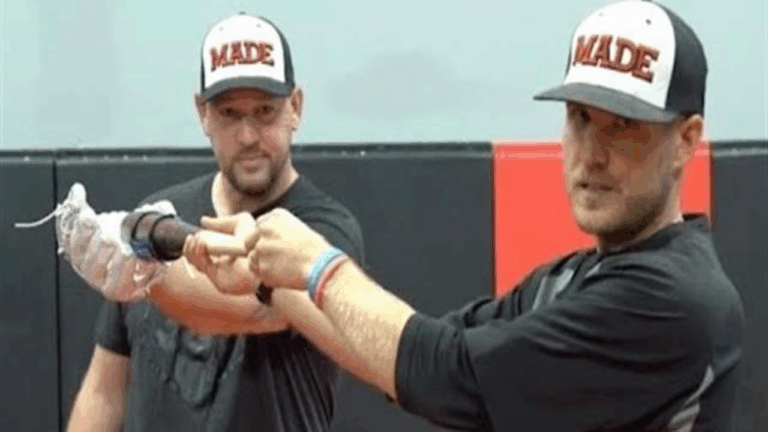

How to Pitch Faster – 7 Proven Steps for More Velocity

If you’re in any baseball Facebook group, you’ve seen this question. Probably today. Probably multiple times.
“How do I pitch faster? I’m 14 and I throw 75. How do I get to 85?”
It’s the most common question in pitching – and it’s also the hardest to answer. Because I don’t know you. I don’t know your age, your body type, your delivery, your work ethic, or your genetics.
But I can give you a framework. In this post, I’m breaking down how to pitch faster with 7 steps – a complete answer that covers every area of velocity development.
In this post, I’m breaking down 7 steps to pitch faster – a complete, blanket answer that covers every area of velocity development. Whether you’re a young pitcher trying to add a few mph or a coach helping your guys get better, this is for you.
Watch the full video above, then use this post as your reference guide.
Step 1: Self-Awareness
Before you do anything else, you need to understand who you are as a pitcher.
Ask yourself:
Why this matters:
If you’re a guy who doesn’t have the same genetics as someone else, and you’re trying to throw 95 mph just because he does, you’re setting yourself up for frustration.
You have to be realistic about what your body can do. That doesn’t mean you can’t get faster – it means you need to understand your starting point.
Step 2: Set a Realistic Goal
Once you know who you are, set a goal that actually makes sense.
Use SMART goals:
|
Letter |
Meaning |
|---|---|
|
S |
Specific |
|
M |
Measurable |
|
A |
Attainable |
|
R |
Realistic |
|
T |
Timely |
Bad Goal:
“I want to be the fastest pitcher ever in the world.”
Is that specific? No. Measurable? Barely. Attainable? Probably not. Timely? We don’t even know when “ever” is.
Good Goal:
“I am going to throw 80 mph by the end of the season.”
Is that specific? Yes. Measurable? Yes, with a radar gun. Attainable? If you’re throwing 75 now, absolutely. Timely? Yes, you put a deadline on it.
The Key Phrase:
Say “I am going to” – not “I want to.”
Write it down. Stick it on your bedroom wall. Every day when you walk out that door, you see it. Even if you don’t read it, you’re acknowledging it.
Step 3: Work on Your Mechanics
Mechanics are the quickest way to improve your pitching velocity.
You can spend months in the gym getting bigger and stronger – and that will help. But fine-tuning your mechanics is faster and safer.
What to do:
Why it works:
When you move efficiently down the mound, you not only throw faster – you stay free from injury. It’s the quickest way and the safest way.
Step 4: Get in the Gym
Now we’re talking about building a stronger, more powerful body.
A Note on Age:
What to Build:
The Formula:
Mechanics + Power = A more explosive athlete moving down the mound with good mechanics.
Think about where you could be when you put those two together.
Important: Get with an experienced trainer who can teach you how to lift the right way. Don’t just wing it.
Step 5: Have the Intent
This is a big one that gets overlooked.
When you’re on the mound – in practice or in a game – you need to have the intent to throw hard.
The Problem:
A lot of guys get so focused on mechanics or throwing strikes that they forget everything else. They’re just trying to “put the ball where they want it” – and their body slows down.
The Fix:
Give your mind and body a task:
“I’m going to throw this ball as fast as I can and hit that spot.”
When you give your body a task, it tries to achieve it. If you’re just lobbing it in for strikes, your body slows down. If you’re going after it, you rare back and let it rip.
The Result:
The more you do this, the more consistent you become. Your body starts to understand that movement pattern – moving fast while trying to throw strikes.
Step 6: Be Consistent
Consistency is hard for pitchers. Hitters can take 100 swings a day. Pitchers can’t throw 100 pitches a day.
But you have to be consistent in practice and in games.
The Mindset:
The Velocity vs. Accuracy Debate:
There’s an argument that says accuracy is better than velocity, or vice versa.
Here’s the truth:
If you throw 100 mph but can’t locate, you’ll never be a great pitcher.
If you throw down the middle with no velocity, you’ll also be a terrible pitcher.
You need both. Stop arguing about which one matters more. Go develop both.
Step 7: Be a Student of the Game
This is the final step, and it’s just as important as the rest.
Ask questions. Reach out to coaches. Join Facebook groups like Professional Baseball Tips and Drills where pro guys are answering questions every day.
But here’s the catch:
With the internet and social media, you’re going to get a hundred different coaches with a hundred different pieces of advice. Some of it will conflict.
Your job as a pitcher:
- Listen to it all
- Take what makes sense to you
- Try it out
- See how it feels
- Keep what’s working
- Get rid of the rest
Build your own pitching philosophy.
At the end of your career, you should be able to say: “This is what worked for me. This was the best for me.”
If you listen to every single piece of information from every single person, you’re going to be so messed up that you’ll never get into a groove.
Remember:
You’re the only guy who’s going to be on the pitching mound during the game. Not your mom. Not your dad. Not your coach. Not the guys on Facebook. You.
So you have to do what you know works. Build your own philosophy.
Quick Summary – The 7 Steps
Step 1: Self-Awareness
Understand your body type and pitching style.
Step 2: Set a Realistic Goal
Use SMART goals. Say “I am going to” – not “I want to.”
Step 3: Work on Your Mechanics
The quickest and safest way to add velocity. Get with a coach.
Step 4: Get in the Gym
Build a strong, explosive body. Get a trainer. (High school age and up.)
Step 5: Have the Intent
Throw every pitch with the intent to throw hard.
Step 6: Be Consistent
Practice and play with the same intent. Develop both velocity and accuracy.
Step 7: Be a Student of the Game
Listen, learn, try, keep what works, and build your own philosophy.
Bonus: Portable Pitching Mounds
If you’re serious about developing your pitching velocity, you need a place to put in the work. We’ve got portable pitching mounds available at ugoprobaseball.com in five different sizes.
Options:
Check the link here to see all the options.
Final Thoughts
Learning how to pitch faster isn’t about one magic drill or one secret tip. It’s a combination of:
Put those seven steps together, and you’ll be on your way to pitching faster – the right way.
Thanks for reading! If this helped you, drop a comment below or share it with a pitcher who needs to hear it.
See you in the next one.
– Coach Madden